
Software development is entering a new era.
For years, AI coding tools have acted as autocomplete engines. They are fast and helpful, but ultimately reactive. Claude Code, developed by Anthropic, changes that dynamic completely.
Claude Code is not just a coding assistant.
It’s an autonomous, agentic development partner capable of understanding, navigating, and transforming entire codebases.
This isn’t about writing code faster.
It’s about redefining how software gets built.
If you’re a developer, the real question is no longer:
“How do I use AI to generate code?”
It’s:
“How do I strategically collaborate with AI to build better systems?”
This guide will help you do exactly that.
What Makes Claude Code Different?
Most AI tools operate at the snippet level.
Claude Code operates at the system level.
It can:
- Understand full project architecture
- Modify multiple files consistently
- Execute terminal commands
- Refactor legacy systems
- Generate tests and documentation
- Integrate into CI/CD workflows
Instead of assisting one line at a time, it reasons through entire development workflows.
The Core Advantage: Agentic Development
Claude Code functions as an AI agent capable of multi-step reasoning and execution.
That means it can:
- Identify a problem
- Trace dependencies across files
- Propose and apply fixes
- Update tests
- Validate outcomes
You’re no longer micromanaging instructions. You’re defining outcomes.
That’s a massive leverage shift.
The Four Strategic Pillars of Claude Code
Claude Code’s real power isn’t just in generating code, it’s in how it integrates into your entire development workflow. Its impact can be understood through four strategic pillars:
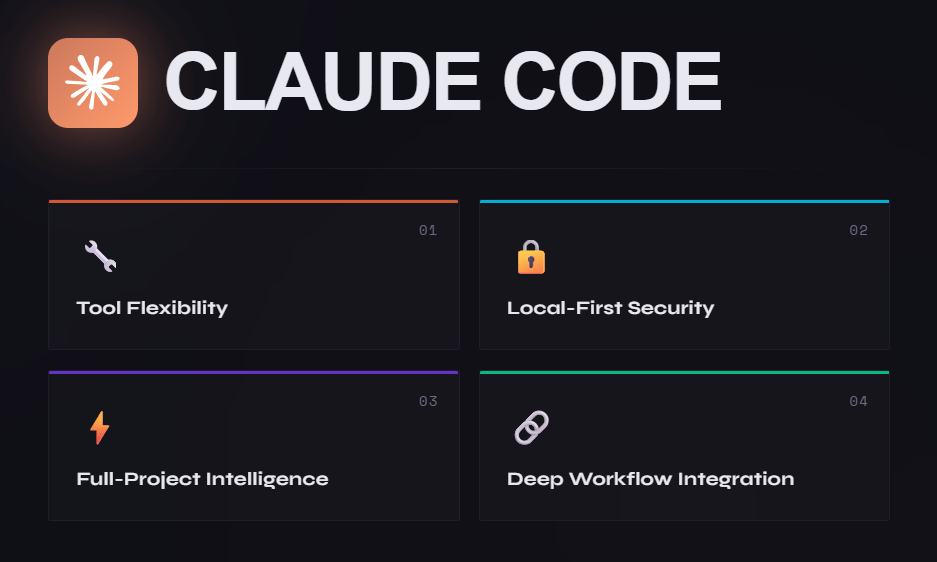
1️⃣ Tool Flexibility
Claude Code is editor-agnostic. Whether you use VS Code, Vim, Emacs, JetBrains IDEs, or terminal-based workflows, it adapts to your preferred setup.
Why it matters: You don’t need to change your workflow to adopt AI. Claude Code integrates into the tools you already trust.
2️⃣ Local-First Security
Claude Code is designed with a local-first philosophy. Your code is processed securely without being stored or used for training, helping maintain privacy and compliance.
Why it matters: For startups and enterprises alike, protecting intellectual property and sensitive codebases is critical.
3️⃣ Full-Project Intelligence
Unlike snippet-based assistants, Claude Code understands relationships across your entire codebase — not just the file you’re editing. Renaming a core model, updating shared interfaces, or refactoring legacy services — it handles them all with full context.
Why it matters: This enables safer refactoring, consistent multi-file updates, and better architectural decisions.
4️⃣ Deep Workflow Integration
Claude Code integrates directly with your development ecosystem — including Git workflows, package managers, and infrastructure tooling.
Why it matters: It doesn’t just generate code. It participates in your development lifecycle.
Together, these four pillars shift AI from being a passive suggestion tool to an active engineering collaborator.
Model Context Protocol (MCP): Beyond Code Generation
Claude Code’s power expands through the Model Context Protocol (MCP).
MCP allows it to connect with:
- APIs
- CI/CD systems
- Infrastructure tools
- External services
This transforms it from a coding assistant into a workflow orchestrator.
Imagine:
- Automatically provisioning infrastructure
- Generating and validating API specs
- Updating documentation during deployment
- Coordinating multiple development tasks simultaneously
That’s automation at scale.
Agent Teams: Parallelizing Intelligence
Claude Code enables specialized agent configurations, where different agents focus on distinct responsibilities:
- Testing
- Linting
- Documentation
- Performance optimization
- Security analysis
Instead of a single AI helper, you can orchestrate a team of AI collaborators.
This dramatically accelerates development cycles while maintaining structure.
Strategic Adoption: Don’t Just Use It, Master It
To extract real value, developers must approach Claude Code strategically.
Stage 1: Build Trust
Start with:
- Code explanations
- Unit test generation
- Minor refactoring
Learn how it reasons.
Understand its boundaries.
Stage 2: Amplify Productivity
Move into:
- Multi-file updates
- Bug tracing workflows
- Test-driven development collaboration
- Automated Git commit drafting
Here, you’ll start feeling the compounding speed.
Stage 3: Engineer with Leverage
Advanced users can:
- Configure agent teams
- Integrate MCP workflows
- Automate infrastructure provisioning
- Transform legacy architectures
At this stage, Claude Code becomes a force multiplier.
Best Practices for Maximum Impact
Claude Code is powerful, but power requires discipline.
1. Define Clear Success Criteria
Provide explicit goals and validation requirements.
2. Always Verify with Tests
AI accelerates execution; you remain accountable for correctness.
3. Use Context Documentation
Maintain structured architectural guidance (e.g., CLAUDE.md) to ensure consistent outputs.
4. Scope Tasks Intelligently
Break large initiatives into structured steps to optimize reasoning.
5. Integrate with Version Control
Every AI-driven change should be reviewable, auditable, and reversible.
AI should increase confidence, not reduce it.
Limitations You Must Respect
Even advanced AI has constraints:
- Finite context windows
- Dependence on accurate prompts
- Limited empirical research on long-term maintenance
Claude Code does not replace architectural judgment.
It enhances it.
Developers who treat it as an autopilot risk errors.
Developers who treat it as a collaborator unlock leverage.
Conclusion: A Competitive Advantage for Forward-Thinking Developers
Claude Code represents a structural shift in how software gets built — moving from isolated assistance to autonomous collaboration.
When used strategically, it enables developers to:
- Accelerate delivery cycles
- Improve code quality
- Reduce repetitive workload
- Modernize complex systems
- Focus on higher value engineering decisions
The future of development is not human vs. AI.
It’s human strategy amplified by AI execution.
Developers who master Claude Code today won’t just work faster — they’ll build smarter.


 Purnananda Behera
Leave a comment